AI Overview
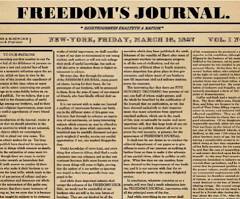
Black media started in the United States in 1827 with the launch of Freedom’s Journal, the first Black-owned and operated newspaper, established in New York City by Samuel Cornish and John B. Russwurm to give African Americans an independent voice against oppression and advocate for abolition, marking a vital act of resistance that paved the way for the broader Black Press.
Key Milestones & Growth:
- Freedom’s Journal (1827): Its motto, “We wish to plead our own cause,” set the tone for the independent Black press, which chronicled Black life and fought for rights.
- Post-Civil War Expansion: Hundreds of Black newspapers emerged, especially in the South, as Black people claimed their freedom and asserted citizenship, combating Jim Crow and lynchings.
- The North Star (1847): Frederick Douglass‘s influential abolitionist paper further solidified the Black press’s role in social and political discourse.
- Magazines & Broadcast (20th Century): While newspapers dominated, the 1940s saw major Black magazines like Ebony develop, and by the 1970s, Black entrepreneurs began acquiring radio and TV stations, creating new avenues for Black voices.
Significance:
The Black press has always been more than news; it’s been a tool for survival, community building, political empowerment, and preserving Black history, acting as a crucial counter-narrative to mainstream media.
Black media in the United States officially began in 1827 with the publication of the first Black-owned and operated newspaper. Over nearly 200 years, it has expanded from abolitionist print journals to include national magazines, radio, television, and digital platforms.
Key Milestones in Early Black Media
- First Newspaper (1827): Freedom’s Journal was founded in New York City by Samuel Cornish and John Russwurm. Its mission was famously stated in its first issue: “We wish to plead our own cause. Too long have others spoken for us”.
- Influential Abolitionist Press (1847): Frederick Douglass founded The North Star in Rochester, New York, which became the leading anti-slavery newspaper of its time.
- Oldest Continuously Published Paper (1852): The Christian Recorder, established by the African Methodist Episcopal Church, is the oldest Black newspaper still in publication today.
- First Black Woman Publisher (1853): Mary Ann Shadd Cary launched the Provincial Freeman in Canada, making her the first Black woman in North America to edit and publish a newspaper.
- First National Magazine (1910): The Crisis was founded by W.E.B. Du Bois as the official publication of the NAACP.
Expansion into Broadcast and Modern Media
- First TV Appearance (1939): Ethel Waters became the first Black performer on television with her variety special, The Ethel Waters Show, on NBC.
- Golden Age of Magazines (1940s–1950s): John H. Johnson founded Negro Digest (1942), Ebony (1945), and Jet (1951), creating a massive commercial platform for Black culture and news.
- Television Network (1980): Black Entertainment Television (BET) was founded by Robert L. Johnson and Sheila Johnson, initially launching as a programming block before becoming its own channel.
- Digital Transformation (2000s–Present): Established outlets like the Baltimore Afro-American (founded 1892) moved online, while new digital-first platforms like The Grio, The Root, and Black Voice News emerged to serve the community on the internet
The Chicago Defender began publication on May 5, 1905. Founded by Robert Sengstacke Abbott, the paper began as a weekly publication with an initial investment of just 25 cents and a print run of 300 copies. At its inception, Abbott produced the newspaper from a small kitchen in his landlord’s apartment.
Key Developments in Its History
- The Great Migration: In its early decades, the Defender became a major catalyst for the Great Migration, actively encouraging Black Southerners to move to the industrial North for better opportunities.
- National Reach: By World War I, it was the most influential Black newspaper in the U.S., with over two-thirds of its readership located outside of Chicago.
- Daily Publication: On February 6, 1956, it transitioned to a daily format known as the Chicago Daily Defender, becoming the nation’s second Black daily newspaper.
- Digital Shift: The Defender ceased its regular print edition in 2019 to focus exclusively on its digital platform.
The paper remains active today as a digital-first publication, continuing its legacy of reporting on issues central to the African American community.
In addition to the Chicago Defender, several other Black newspapers played critical roles in shaping African American life and advocacy during the early 20th century.
Major National and Regional Influencers
- Pittsburgh Courier (Founded 1910): By the 1930s, the Courier became the most widely circulated Black newspaper in the U.S.. It is best known for launching the “Double V” campaign during World War II, which demanded victory against fascism abroad and victory against racism at home.
- Baltimore Afro-American (Founded 1892): One of the most widely circulated papers on the Atlantic Coast, it was the first Black newspaper to station correspondents overseas during World War II. It also employed notable intellectuals like Langston Hughes.
- New York Amsterdam News (Founded 1909): A leading voice for the Harlem community, it gained national prominence in the 1940s for its advocacy for military desegregation and its extensive coverage of the Harlem Renaissance.
- Norfolk Journal and Guide (Founded 1910): Based in Virginia, this paper provided a more moderate but essential southern perspective. It notably offered the only on-the-scene, day-to-day coverage of the Scottsboro Boys trial in the 1930s.
- Philadelphia Tribune (Founded 1884): Dedicated to the needs of one of the nation’s largest Black communities, it is recognized as the oldest continuously published Black newspaper in the U.S..
Other Notable Publications
- The California Eagle (Founded 1879): The oldest African American newspaper in the West, it was a primary resource for Black settlers moving to Los Angeles, providing critical housing and job information.
- Atlanta Daily World (Founded 1928): It became the first Black daily newspaper in the modern era, starting in 1932.
- The Guardian (Founded 1901): Published in Boston by William Monroe Trotter, it was known for its militant stance against racial injustice and its frequent critiques of Booker T. Washington’s accommodationist views.
- The Woman’s Era (Founded 1894): The first nationally distributed newspaper published by and for African American women, serving as the official organ for several national women’s associations.
Some Of The Current Newspapers in Chicago
- The Chicago Defender: While it ceased print publication in 2019, it operates as a digitally-focused content platform, continuing its legacy of news, information, and events relevant to the urban African American community.
- Chicago Citizen Newspaper Group: This group publishes several local weekly papers covering specific South Side communities, including the Chatham Citizen and Hyde Park Citizen.
- The Final Call: Established in 1979, this newspaper serves as the official publication of the Nation of Islam and is distributed twice monthly.
- The Austin Weekly News: Serving the Austin neighborhood on Chicago’s West Side, this paper is still in publication.
- The Chicago Crusader was first published in June 1940. It was co-founded by businessman and labor leader Balm L. Leavell Jr. and his partner Joseph H. Jefferson. The paper originally grew out of a one-page newsletter for the Negro Labor Relations League (NLRL) and was first produced in an apartment in the Ida B. Wells housing projects.
- The Chicago Reporter is a nonprofit investigative news organization that has focused on issues of race and poverty in Chicago since its founding in 1972.
- Windy City Word Mission: It is a Black-owned and operated newspaper dedicated to providing a positive image and voice for the Greater West Side communities, including Austin, East Garfield Park, and West Garfield Park, since the early 1990’s.
- The South Street Journal (SSJ) was an influential community newspaper serving Chicago’s South Side, specifically the Bronzeville and Black Metropolis areas, from the early 1990s through the mid-2010s.
- Chicago Communicator News Media (CCNM) was an independent nonprofit media organization established in 2002. Founder and Publisher: The organization was founded and led by Wanda Carter, who serves as its publisher. Currently, a digital presentation is available at http://www.ccnewsmedia.org
Historical/Defunct Newspapers
Chicago has hosted an estimated 190 Black newspapers since its first one was established. Notable historical examples include:
- The Chicago Conservator: The first Black newspaper in Chicago, established in 1878.
- The Chicago Bee: Founded by businessman Anthony Overton in 1925, the paper was published until 1947.
- Muhammad Speaks: Published between 1961 and 1975, this publication had a major national circulation and impact.
- The Broad Ax: A weekly paper that moved to Chicago in 1899 and was published until 1935.